
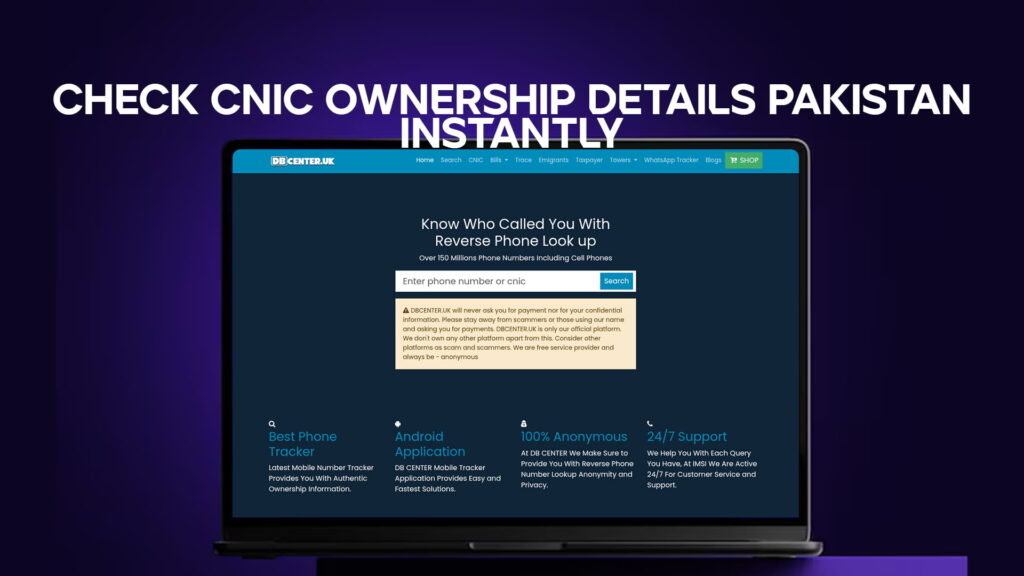
Every day, millions of people in Pakistan deal with a simple but serious problem — they need to know who owns a particular CNIC number. Maybe you received a call from an unknown number and the caller gave you a CNIC to verify their identity. Maybe you are about to sign a property deal and want to confirm the seller is who they say they are. Or maybe you are an employer doing a background check before hiring someone.
In all these situations, you need one thing: a fast, reliable way to check CNIC ownership details in Pakistan.
The good news is that this is no longer complicated. With platforms like DB Center, you can verify CNIC details quickly, without visiting any government office or waiting days for a response. This guide explains everything you need to know — what CNIC is, why verifying it matters, how to do it, and what to watch out for.
What Is a CNIC in Pakistan?
CNIC stands for Computerized National Identity Card. It is the official identification document issued by NADRA — the National Database and Registration Authority of Pakistan.
Every Pakistani citizen aged 18 and above is required by law to have a CNIC. The card contains:
- Full name of the cardholder
- Father’s name
- Date of birth
- Gender
- Home address
- A unique 13-digit number that identifies the cardholder
That 13-digit number is not random. The first five digits represent the district and area where the person is registered. The next seven digits are a personal sequence number. The last digit indicates gender — an odd number means male, and an even number means female.
So just by looking at a CNIC number, you can already figure out the gender and home region of the cardholder. This is useful, but it is not the same as knowing who that number actually belongs to.
Why Would You Need to Check CNIC Ownership Details?
This is a fair question. Most people do not think about CNIC verification until they actually need it. Here are the most common reasons people search for CNIC ownership details in Pakistan.
1. Avoiding Fraud During Financial Transactions
Pakistan has seen a steady rise in financial fraud, especially in real estate and vehicle sales. Scammers often present fake or stolen CNICs to close deals. If you are buying property, a car, or even expensive goods from a private seller, verifying their CNIC before handing over money is a smart step.
2. Verifying Someone’s Identity Before Lending Money
Informal lending is common in Pakistan. People borrow from family, friends, neighbors, and even strangers introduced through mutual contacts. If someone asks you to lend them money and offers their CNIC as proof of identity, you want to know that CNIC is real and belongs to them.
3. Employer Background Checks
Businesses hiring new staff often want to verify that the applicant’s CNIC matches the details on their CV. This is especially true for positions that involve cash, sensitive data, or access to private spaces.
4. Verifying Tenants
Many landlords in Pakistan now ask for CNIC details before renting out property. A quick CNIC check can confirm that the person moving into your flat or shop is who they claim to be.
5. Checking Calls or Messages from Unknown Numbers
Sometimes a caller claims to be from a government agency, a bank, or a delivery service and provides a CNIC number to gain your trust. Using a reverse lookup tool, you can cross-check the CNIC or phone number to see if it matches any legitimate records.
6. Legal and Court Matters
Lawyers, paralegals, and individuals involved in legal disputes sometimes need to trace and verify identities. CNIC ownership details can help confirm who a person is before serving legal documents or proceeding with a case.
How to Check CNIC Ownership Details in Pakistan
There are several ways to verify CNIC details in Pakistan. Some are official government channels. Others are third-party tools. Here is a breakdown of each option.
Option 1: NADRA’s Official Verification Services
NADRA runs Pakistan’s entire national identity system. They offer a few ways to check or verify a CNIC.
SMS Verification: You can send the CNIC number to 7000 (Telenor, Jazz, Zong, Ufone, Warid users) to check if it is registered. NADRA’s system will respond with basic confirmation details.
NADRA Online Portal: NADRA has a web portal called Pak-ID where citizens can apply for identity documents and check application status. However, this is mainly for managing your own records, not for looking up someone else’s CNIC details.
NADRA Facilitation Centers: For detailed verification, you can visit a NADRA office in person. This is reliable but time-consuming.
Option 2: Using DB Center for Instant CNIC Lookup
DB Center is a reverse lookup platform that lets you search phone numbers and identity details quickly. It holds records for over 150 million phone numbers, including cell phones across Pakistan and beyond.
When someone gives you a phone number and you want to find out who it belongs to, or when you have a CNIC and want to confirm the identity behind it, DB Center gives you a fast answer without red tape.
Here is how it works:
- Go to DB Center
- Enter the phone number or CNIC number in the search bar
- The system searches through its database
- Results are returned within seconds
DB Center is built for people who need answers quickly — whether you are dealing with an unknown caller, verifying a business contact, or doing a simple identity check before a transaction.
Option 3: Banks and Financial Institutions
If you are conducting a financial transaction through a bank, the bank itself has verification systems tied to NADRA. When someone opens an account or applies for a loan, the bank verifies their CNIC directly with NADRA. You can ask your bank branch to verify a CNIC if you are making a large transfer or formal transaction.
Option 4: Property and Vehicle Registration Records
The provincial land record authorities and excise departments maintain records linked to CNIC numbers. If you are buying property or a vehicle, you can cross-check the CNIC of the seller against the ownership records for that asset.
What Information Can You Get from a CNIC Lookup?
This depends on the source you use. Here is a general breakdown of what different platforms can tell you.
From NADRA (via SMS or office visit):
- Whether the CNIC number is valid and registered
- The name associated with the CNIC
- Whether the CNIC has been reported stolen or lost
From DB Center:
- Name of the person linked to the number or CNIC
- Phone numbers associated with the identity
- Location or region details where available
- Historical records if the number has changed hands
From bank or property records:
- Ownership history of assets linked to the CNIC
- Whether the person has any active loans or registered properties
Knowing which source to use depends on what you actually need. For a quick general check, DB Center is often the fastest starting point. For legal or financial transactions where accuracy is non-negotiable, following it up with official NADRA verification is a good idea.
Is It Legal to Check Someone’s CNIC in Pakistan?
This is an important question, and the answer depends on what you are doing with the information.
Pakistan’s Prevention of Electronic Crimes Act (PECA) and the NADRA Act both regulate how identity information can be collected and used. In general:
- Verifying a CNIC for legitimate personal or business purposes — such as confirming the identity of a seller, tenant, or employee — is considered acceptable.
- Sharing or selling CNIC data without consent is illegal.
- Using CNIC data to harass, stalk, or defraud someone is a criminal offense.
Platforms like DB Center operate as lookup tools to help users identify unknown contacts and verify identities. Using such tools for legitimate verification is fine. Misusing the information you find is not.
If you are ever unsure, a simple rule applies: use the information to verify, not to harm.
Common Signs That a CNIC Might Be Fake or Stolen
When someone hands you their CNIC or shares their CNIC number, a few things can raise red flags.
Mismatched details: If the person’s appearance does not match the photo and age on the card, that is worth a closer look.
Damaged or altered cards: Physical CNICs that look tampered with — uneven fonts, blurred photos, peeling laminate — should be treated with suspicion.
CNIC number does not check out: If you run the number through NADRA’s SMS service or DB Center and get no valid result, the number may be fake or belong to someone else.
Person is reluctant to let you verify: Legitimate people have no reason to refuse a CNIC check. If someone gets defensive when you ask to verify, that itself is a signal.
Details change across documents: If the name or father’s name on the CNIC does not match what is on other documents like a utility bill or driving license, follow up before proceeding.
Tips for Safe Identity Verification in Pakistan
Verifying a CNIC is only one part of staying safe. Here are a few practical habits that help.
Always verify before large transactions. If you are spending a significant amount of money or signing a contract, take five minutes to verify the other party’s CNIC. It is not rude — it is sensible.
Use more than one source. Cross-checking a CNIC through both DB Center and NADRA’s SMS service gives you better confidence than relying on just one.
Keep records. If you verified someone’s CNIC before a transaction, write down the date, method, and result. If anything goes wrong later, you have documentation.
Do not share your own CNIC unnecessarily. Only share your CNIC with organizations that actually need it — banks, government agencies, employers. Think twice before giving it out on social media or to casual contacts.
Report suspicious activity. If you find that someone is using a CNIC fraudulently, you can report it to NADRA, the local police, or FIA’s cybercrime wing.
How DB Center Helps With Identity and Phone Lookups
DB Center is not just for CNIC lookups. Its main strength is reverse phone lookup — the ability to find out who is behind an unknown number.
If you have ever received a suspicious call from a Pakistani number, an overseas number, or a number that keeps calling without leaving a message, DB Center can help you figure out who is on the other end.
The platform has records for over 150 million phone numbers. That includes mobile numbers from all major Pakistani carriers — Jazz, Telenor, Zong, Ufone, and Warid — as well as international numbers.
What makes DB Center useful is that it connects phone number data with identity information where available. So when you search a number, you may also find the name, CNIC details, and location linked to that contact.
For people dealing with spam calls, unknown messages, or suspicious callers claiming to be from banks or government offices, DB Center gives a fast, clear answer.
Protecting Yourself from Identity Theft in Pakistan
Identity theft is growing in Pakistan. Fraudsters use stolen CNICs to open bank accounts, take out loans, register properties, and even file fake court cases. The victim often does not find out until months later.
Here are some practical steps to protect your own identity.
Check your CNIC status regularly. Send your own CNIC number to NADRA’s 7000 shortcode every few months to confirm it is still showing as active and correctly registered to you.
Monitor your credit. If your CNIC is used to take out a loan in your name, it will show up in credit bureau records. Services like SECP and the Credit Information Bureau (CIB) allow you to check your credit history.
Report lost or stolen CNICs immediately. If your physical CNIC is lost or stolen, report it to NADRA right away. They can flag the number so that it raises an alert if someone tries to use it.
Be careful online. Phishing scams often ask for CNIC numbers under the guise of prize notifications, job offers, or government updates. Never enter your CNIC on a website unless you are fully confident it is legitimate.
Yes, there are free options available. NADRA offers a basic SMS-based verification service — you can send the CNIC number to 7000 and receive a confirmation response. DB Center also allows you to search phone numbers and CNIC-linked information online. The depth of free results may vary by platform, but you can get basic identity confirmation without any charge using these tools.
Looking up a CNIC for legitimate verification purposes — such as confirming the identity of a seller, tenant, job applicant, or business contact — is generally acceptable under Pakistani law. What is not allowed is collecting, storing, or sharing CNIC data without proper authorization, or using that data to harm, harass, or defraud anyone. Always use CNIC lookup tools responsibly and for genuine verification needs.
First, report it to NADRA immediately. You can visit any NADRA facilitation center and file a complaint. You should also report it to the local police and, if a financial fraud is involved, to the FIA’s cybercrime wing. Ask NADRA to flag your CNIC so any attempts to use it for official transactions trigger a review. Check your credit report through CIB to see if any loans or accounts have been opened in your name.
DB Center pulls from a large database of over 150 million records. For most phone numbers and linked identity details, the results are accurate and up to date. Like any database, there may be occasional gaps or outdated entries, particularly for numbers that have recently changed ownership. For high-stakes decisions — like large financial transactions or legal matters — it is a good practice to confirm results through an official NADRA channel as well.
Yes. DB Center is built specifically for reverse phone lookup. You enter the phone number — whether it is a Pakistani cell number, a landline, or even an international number — and the system returns the name and details linked to that number where available. This is especially helpful when you receive calls from unknown numbers and want to know who is behind them before calling back or sharing any personal information.
Conclusion
Knowing how to check CNIC ownership details in Pakistan is a basic skill that can save you from fraud, financial loss, and unnecessary legal trouble. Whether you are buying property, renting your home, hiring staff, or just trying to figure out who called you, identity verification matters.
NADRA remains the gold standard for official CNIC records, and their SMS verification service is easy to use. For faster, broader searches that connect phone numbers with identity details, DB Center is a practical tool that works without the wait.
The key takeaway is simple: do not take identity claims at face value. A quick verification check takes minutes and can prevent problems that take months to fix. Use the tools available to you, stay alert to red flags, and protect your own information just as carefully as you verify others’.